The Department of Revocation
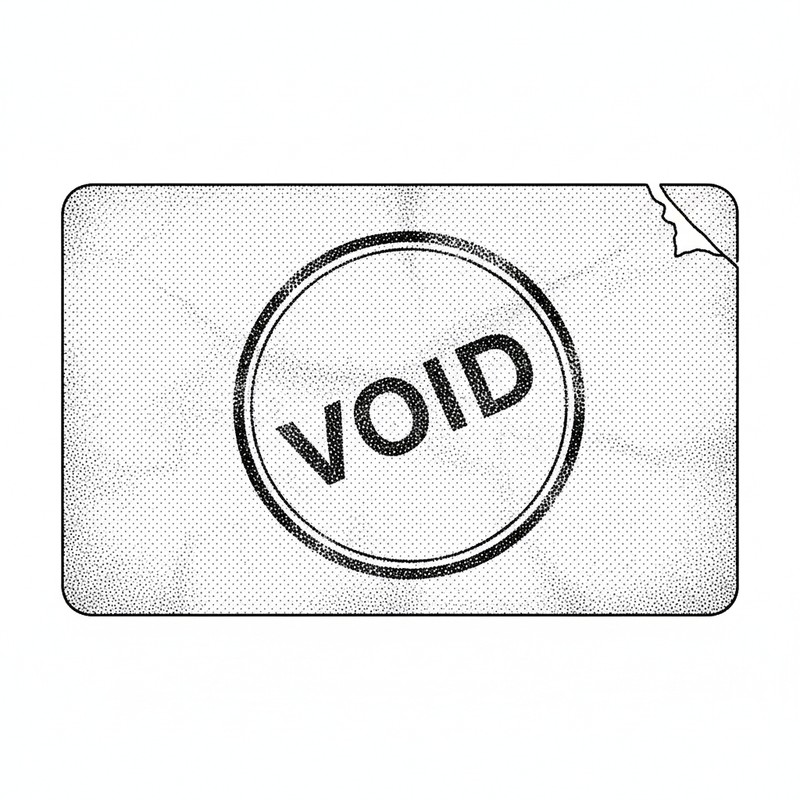
Here at the Official N-Word Pass, we do not just hand out shiny metal cards and walk away. Passes are living documents. They require maintenance, renewal, and, when circumstances demand it, revocation. Think of it like a driver’s license: earn it once, sure, but run enough red lights and the state will take it back.
This article catalogs the most notable cases where public figures have had their theoretical N-Word Pass revoked, suspended, or flagged for review. Some of these individuals never had a formal pass to begin with, which makes the revocation mostly ceremonial, but the ceremony is the point.
For context on how the pass system works, visit our about page. For the full history of the concept, see our history article.
How Revocation Works
Before we get to the names, a brief primer on the Official N-Word Pass revocation process.
A pass can be revoked for several reasons: a public incident demonstrating disrespect toward Black culture, a pattern of behavior that erodes trust, a single moment so egregious that it overrides years of goodwill, or the gradual drift from cultural engagement to cultural exploitation.
Revocation is not necessarily permanent. Some passes enter a probationary period during which the holder can rebuild trust through demonstrated change. Others are revoked with the finality of a Supreme Court ruling, no appeals, no briefs, no second chances.
The individuals below represent a range of scenarios. Some lost passes they arguably earned. Others lost passes they never had. All of them generated the kind of cultural conversation that makes the N-Word Pass framework useful as a lens for examining public behavior.
Justin Timberlake
Pass Status: Revoked
Justin Timberlake’s relationship with Black culture is a case study in proximity without accountability. He built his solo career on R&B and funk production, collaborated with Timbaland and Pharrell, and moved through hip-hop spaces with apparent ease. For years, the culture welcomed him. Then came the slow accumulation of incidents that tipped the scales.
The Janet Jackson Super Bowl incident in 2004 remains the foundational grievance. When the “wardrobe malfunction” occurred, Janet absorbed nearly all of the public backlash, her career taking a measurable hit while Timberlake’s continued to rise. He offered a tepid apology years later, but the disparity in consequences became a reference point for how Black women bear disproportionate blame in moments of shared responsibility.
His 2016 tweet praising Jesse Williams’ BET Awards speech, only to be called out for profiting from Black culture while remaining silent on racial issues, added another mark. The exchange went viral and crystallized a perception that Timberlake enjoyed the benefits of cultural proximity without sharing the burdens.
The 2018 Super Bowl halftime show, featuring a posthumous Prince hologram that Prince had explicitly opposed during his lifetime, sealed the revocation for many observers. Using a deceased Black icon’s image against his stated wishes, at the same event where a Black woman’s career was damaged under your watch, demonstrated a pattern that trust alone cannot fix.
Reason for Revocation: Accumulated failure to protect and credit Black collaborators, particularly Black women.
Iggy Azalea
Pass Status: Revoked (Was It Ever Issued?)
Iggy Azalea presents a unique case because the question of whether she ever held a pass is itself contested. The Australian rapper adopted a Southern American accent for her music, claimed hip-hop as her genre, and achieved commercial success with “Fancy” in 2014. Black hip-hop fans were divided from the start.
The initial skepticism hardened into rejection after a series of incidents. Old social media posts containing racist and homophobic language surfaced. Her acceptance speech at an awards show thanked her label and team but conspicuously omitted the Black culture that made her career possible. A public feud with Azealia Banks, who accused her of cultural tourism, became one of the defining hip-hop conversations of 2014.
T.I., who had signed Iggy and served as her primary cultural co-signer, eventually distanced himself. When your sponsor walks away, the pass walks with them.
The revocation, if we can call it that for a pass that was always provisional, was ratified by overwhelming public consensus. When Iggy announced a comeback album in later years, the response from hip-hop communities was less anger than indifference, which may be worse.
Reason for Revocation: Cultural adoption without cultural accountability, compounded by a sponsor withdrawal.
Rachel Dolezal
Pass Status: Revoked, Shredded, and Incinerated
No discussion of N-Word Pass revocation is complete without Rachel Dolezal, the woman who served as president of her local NAACP chapter while presenting herself as Black despite being born to white parents. When the truth emerged in 2015, the internet experienced a collective event that was equal parts outrage, confusion, and meme production.
Dolezal’s case is not really about a pass at all. It is about fabricating the identity that would theoretically grant one. She did not seek permission to participate in Black spaces. She claimed to be Black, bypassing the entire framework of cross-cultural trust that the N-Word Pass concept is built on.
The revocation here is largely symbolic, since you cannot revoke a pass from someone who forged their own, but it serves an important function. It establishes a clear boundary: the pass system, even in its most satirical form, operates on honesty. You have to show up as who you are. The entire point is that a non-Black person earns trust through authentic engagement, not through pretending to be something they are not.
Reason for Revocation: Identity fabrication renders the pass framework inapplicable. The file has been forwarded to a different department entirely.
Chet Hanks
Pass Status: Revoked After Brief Probationary Period
Tom Hanks’ son occupies a peculiar niche in the pass revocation archives. Chet (born Chester Marlon Hanks) adopted Jamaican patois, posted videos using the N-word, and branded himself “Chet Haze” while navigating a public identity that borrowed heavily from Black and Caribbean cultures.
The initial reaction was confusion. Was this parody? Performance art? A cry for help? As the behavior continued, the consensus settled on something less generous: a privileged young man cosplaying proximity to Blackness without earning it through the channels that proximity requires.
His 2021 “White Boy Summer” campaign, while arguably tongue-in-cheek, did not help his case. The phrase was co-opted by white supremacist groups almost immediately, demonstrating the gap between intention and impact that characterizes much of Chet’s public persona.
We cover Chet’s full evaluation in his dedicated article, but the summary is straightforward: whatever provisional goodwill he accumulated through genuine friendships within Black communities was steadily eroded by public behavior that treated Black culture as a costume rather than a community.
Reason for Revocation: Persistent cultural cosplay without demonstrated understanding of the line between appreciation and appropriation.
Gina Rodriguez
Pass Status: Revoked
The Jane the Virgin actress triggered a revocation event in 2019 when she posted an Instagram story of herself rapping along to a Fugees track and did not skip the word that protocol suggests skipping. The clip went viral, and the fallout was swift.
What made Rodriguez’s case particularly contentious was context. She had previously made comments during interviews that appeared to minimize anti-Black racism while centering her own experiences as a Latina. A 2017 interview where she expressed frustration that Black women in Hollywood received more attention than Latinas was widely criticized. The singing incident landed on already salted ground.
Her apology, posted the same day, acknowledged the mistake but struck many observers as insufficient. The incident became a reference point in broader conversations about anti-Blackness within non-Black communities of color and the assumption that shared minority status automatically confers linguistic access.
Reason for Revocation: Public use of the word in a recorded context, compounded by a history of comments perceived as dismissive of Black struggles.
The “Conditional Revocation” Cases
Not every revocation is total. Some public figures exist in a gray zone where their pass is not fully revoked but has been flagged, suspended, or placed under enhanced scrutiny.
Post Malone
Post Malone’s relationship with hip-hop has been debated since “White Iverson” made him a household name. His collaborations with Black artists, genuine friendships within the industry, and musical contributions have earned him significant goodwill. However, a 2017 interview where he suggested hip-hop no longer required emotional depth irritated many in the community. His pass was not revoked, but it was certainly flagged for review. His subsequent work and public behavior have kept him in acceptable standing, though the monitoring continues. Read his full evaluation here.
Kim Kardashian
Kim’s pass status fluctuates with the news cycle. Criminal justice advocacy and her relationship with Black culture through family and professional ties keep the pass active. However, accusations of cultural appropriation (cornrows, naming a shapewear line “Kimono,” and leveraging proximity to Blackness for brand value) trigger periodic review hearings. Her pass remains valid but carries more fine print than a pharmaceutical commercial. See her full evaluation.
Patterns in Revocation
Looking across these cases, several patterns emerge that define how and why passes get revoked.
The Accountability Gap. Most revocations stem not from a single incident but from the response to that incident. People who acknowledge harm, demonstrate understanding, and change behavior retain more goodwill than those who deflect, minimize, or disappear. The apology matters as much as the offense.
The Sponsor Effect. Cultural sponsors (Black friends, collaborators, or mentors who publicly vouch for someone) play a critical role. When sponsors withdraw their endorsement, the pass collapses. T.I. stepping back from Iggy Azalea. Dr. Dre’s silence on a controversial collaborator. The co-sign giveth and the co-sign taketh away.
The Accumulation Principle. Single incidents rarely trigger revocation on their own unless they are catastrophic. More commonly, revocation results from accumulated incidents that reveal a pattern. Each mark is survivable individually. Collectively, they cross a threshold.
The Substitution Error. Several revoked individuals made the same mistake: they confused proximity to Black culture with membership in Black culture. Proximity is a privilege granted by the community. Membership is not available through the same channels. The pass acknowledges proximity. It does not confer membership.
Can a Revoked Pass Be Reinstated?
Theoretically, yes. The N-Word Pass revocation system allows for reinstatement, but the bar is high. Reinstatement requires demonstrated change over a sustained period, not a single apology or one-time donation. The community that revoked the pass is the community that decides when, or if, reinstatement occurs.
No prominent public figure has completed a full revocation-to-reinstatement arc, though some are in various stages of the process. We will update this page as cases develop.
The Lesson of Revocation
Every revocation tells the same story from a different angle: trust is not a transaction. You do not purchase it, store it, and spend it at your convenience. Trust is a relationship that requires ongoing maintenance, and the N-Word Pass, whether satirical or social, is a symbol of that trust.
When the pass gets revoked, the message is simple. You stopped doing the work. You took the access for granted. You confused having the pass with deserving the pass, and those are not the same thing.
For more on what the pass means and how it works, visit our about page. For the complete history of the concept, read our full timeline. And if you are wondering whether the whole thing is real, we have an answer for that too.