Introduction
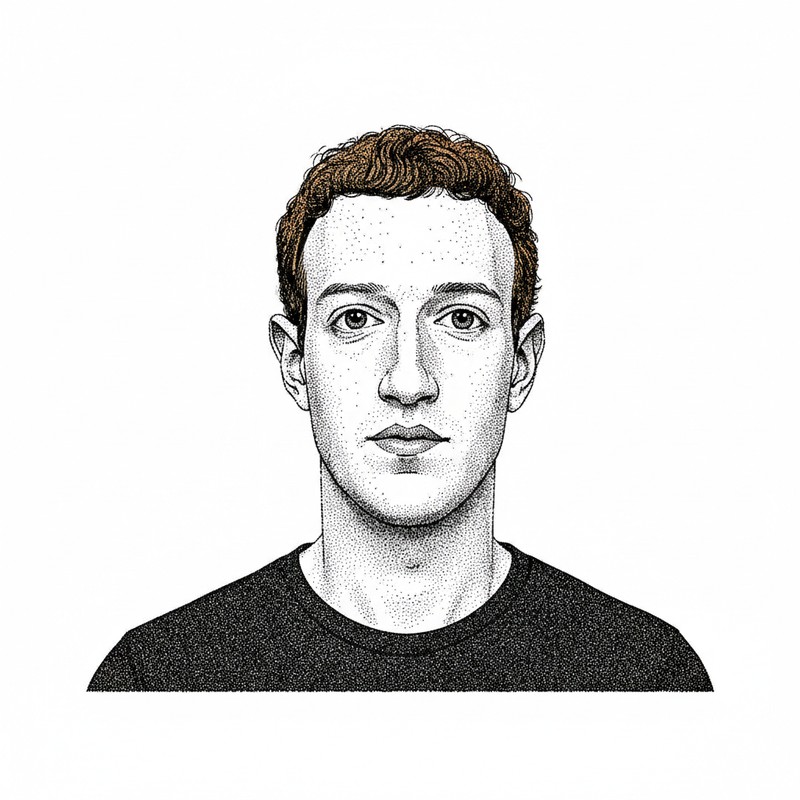
Case File #MZ-2025-0515. Subject: Mark Elliot Zuckerberg. Filed under: Tech Billionaires; Individuals Whose Personal Rebrand Has Caused Institutional Concern; Men Who Started Wearing Gold Chains in Their Late Thirties and Expected Nobody to Comment; Owners of Platforms That Have Enabled More Hate Speech Than Any Other Communication Technology Since the Printing Press.
The Board of Review has opened a formal evaluation into the N-Word Pass eligibility of Mark Elliot Zuckerberg, co-founder and CEO of Meta Platforms, Inc., the man who built the world’s largest social media infrastructure from a Harvard dormitory and has spent the subsequent two decades demonstrating that building something does not require understanding its consequences.
The Board will confess at the outset that this file arrived at the evaluation desk and produced a silence that lasted several minutes. The Board members looked at the file. The file looked back. Eventually, someone said, “Well, we have to evaluate it.” Protocol demands thoroughness.
The biographical record. Mark Zuckerberg was born on May 14, 1984, in White Plains, New York, to a dentist and a psychiatrist. He attended Phillips Exeter Academy, a preparatory school whose annual tuition exceeds the median household income of most American cities. He enrolled at Harvard University. He launched Facebook from his dormitory room in 2004. The original version of the site included a feature called “Facemash” that invited users to compare photographs of female students and rate their attractiveness, which the Board enters into the record as an early indicator of the subject’s relationship with consent and the commodification of human beings.
By 2012, Facebook had one billion users. By 2021, the company had rebranded to Meta and Zuckerberg was publicly committed to building “the metaverse,” a virtual reality platform that, as of this evaluation, has consumed approximately $50 billion in investment and produced a VR world inhabited primarily by legless avatars. In 2023 and 2024, Zuckerberg underwent what cultural commentators have described as a “personal rebrand”: he began training in mixed martial arts, wearing gold chains, posting workout videos, and generally presenting a persona that bore almost no resemblance to the pale, hoodie-wearing automaton the public had spent two decades observing.
The Board has questions. Many of them.
Cultural Context
The N-Word Pass evaluation framework assesses cultural engagement, reciprocity, community trust, and authentic connection to Black culture. It was designed to evaluate musicians, entertainers, and public figures whose careers intersect with Black cultural spaces in documented and observable ways. It was not specifically designed to evaluate a tech billionaire who recently started wearing a gold chain and learning to grapple, but the Board adapts.
Zuckerberg’s relevance to Black culture is primarily structural rather than personal. Facebook, Instagram, and WhatsApp serve as the primary digital infrastructure for Black communities worldwide. Black creators on Instagram have built careers, businesses, and cultural movements using Meta’s platforms. Black Lives Matter organized on Facebook. Black churches stream services on Facebook Live. Black-owned businesses use Instagram as their primary storefront. The infrastructure Zuckerberg built is, in practice, deeply embedded in Black daily life.
That structural relevance does not confer personal cultural standing. The man who owns the highway is not a member of every community the highway passes through. The Board evaluates individuals, not their corporate products.
The more immediate cultural question involves Zuckerberg’s recent aesthetic transformation, which the Board addresses in the sections that follow.
The Case For
Meta’s Platforms Serve as Infrastructure for Black Communities
Facebook and Instagram are, functionally, essential infrastructure for Black cultural production, political organizing, and economic activity. The platforms host Black-owned businesses, amplify Black creators, and provide the digital spaces where Black community conversations occur daily. Zuckerberg built these platforms. The fact that they serve Black communities is not incidental to their design but rather a consequence of building platforms that serve everyone. The Board notes this structural contribution while reiterating that infrastructure provision is not the same as cultural engagement.
The Chan Zuckerberg Initiative Has Funded Black-Serving Organizations
The Chan Zuckerberg Initiative (CZI), the philanthropic organization run by Zuckerberg and his wife Priscilla Chan, has directed funding to criminal justice reform, education equity, and community organizations that serve Black populations. CZI’s support for The Justice Accelerator, which funds community-based alternatives to incarceration, addresses issues that disproportionately affect Black Americans. The Board acknowledges this investment while noting that philanthropy conducted through an institutional vehicle is not evidence of personal cultural connection.
The MMA Training Involves Engagement with Diverse Athletic Communities
Zuckerberg’s mixed martial arts training has placed him in gyms and training environments that are, by the nature of combat sports, diverse. MMA’s roster includes fighters from every racial and ethnic background, and the sport’s culture emphasizes respect earned through shared physical hardship. The Board notes this as the thinnest possible form of cross-cultural exposure and declines to weight it heavily.
The Case Against
Meta’s Platforms Have Enabled Racism at Historic Scale
Facebook’s algorithm has been documented, by the company’s own internal research, to amplify inflammatory content including racist speech, white supremacist organizing, and disinformation targeting Black communities. The platform was used to coordinate the Unite the Right rally in Charlottesville. Internal documents leaked by whistleblower Frances Haugen in 2021 revealed that the company was aware its algorithm promoted divisive content and chose to prioritize engagement metrics over user safety.
Instagram’s algorithm has been documented to suppress Black creators’ content through shadowbanning, particularly when those creators discuss racial justice. Black users have reported disproportionate account suspensions for content that is substantially similar to content posted by white users without consequence. The platform’s content moderation policies have been applied unevenly along racial lines, a pattern documented by external researchers and by Meta’s own civil rights auditors.
The Board weighs this heavily. The subject built and operates platforms that have functioned as force multipliers for anti-Black racism. Whether this outcome was intentional is irrelevant to the evaluation. The N-Word Pass framework assesses impact, not intent.
The Aesthetic Rebrand Is Exactly What It Looks Like
In the span of approximately eighteen months, Mark Zuckerberg went from a man who wore the same grey t-shirt every day to a man who wears gold chains, posts MMA training footage set to hip-hop music, and generally presents a persona that borrows liberally from aesthetic traditions associated with Black and Latino culture. The gold chain, in particular, carries cultural weight. Within hip-hop and Black American culture, gold chains are a symbol of success and self-determination, worn by people whose communities were denied access to wealth for generations. When a billionaire who grew up in White Plains and attended Phillips Exeter Academy starts wearing gold chains, the Board must ask what, exactly, is being communicated.
The answer, in the Board’s assessment, is: a man who spent two decades being perceived as a robot is attempting to be perceived as a person, and the personality he has selected borrows from cultural traditions he has no meaningful connection to. This is cosplay with a marketing budget.
Facebook’s Role in the Rohingya Genocide and Global Harm to Communities of Color
Facebook was identified by United Nations investigators as having played a “determining role” in the genocide of Rohingya Muslims in Myanmar. The platform has been linked to ethnic violence in Ethiopia, India, and Sri Lanka, affecting communities of color worldwide. While these cases extend beyond the Board’s primary focus on Black American communities, they demonstrate a pattern of structural harm to communities of color globally that the subject has been unable or unwilling to prevent.
The “Move Fast and Break Things” Philosophy Has Broken Black Communities’ Trust
Zuckerberg’s corporate motto in Facebook’s early years was “move fast and break things.” The Board notes that among the things that were broken: the information ecosystem of Black communities, whose feeds were flooded with misinformation; the economic prospects of Black creators, whose content was suppressed or stolen; and the organizing infrastructure of racial justice movements, whose pages and groups were subject to inconsistent enforcement and surveillance. Breaking things is easy when you are not the one who has to live in the wreckage.
Zero Personal Cultural Connection to Black Communities
The Board has reviewed the available public record and has found no evidence of personal, sustained, non-transactional engagement with Black communities by Mark Zuckerberg. No documented friendships with Black cultural figures that predate the aesthetic rebrand. No history of attending Black cultural events outside of corporate-sponsored appearances. No musical literacy, artistic engagement, or community presence that would suggest organic connection to the culture whose aesthetics he has recently adopted.
The Eminem evaluation documents an applicant whose cultural connections were forged through years of physical presence in Black spaces, earning trust through demonstrated skill and genuine relationship-building. The Zuckerberg file contains a man who downloaded the aesthetic package without reading the terms of service.
Deeper Analysis
The Zuckerberg evaluation is, in the Board’s assessment, a case study in the difference between proximity and participation. Meta’s platforms create proximity to every culture on earth. Proximity is not participation. A satellite orbiting the planet passes over every country. It is not a citizen of any of them.
The aesthetic rebrand warrants specific examination because it illustrates a phenomenon the Board has observed with increasing frequency: wealthy individuals who, having achieved financial dominance, attempt to purchase cultural credibility by adopting the external markers of cultures they have no organic connection to. The gold chain, the MMA training, the carefully curated social media presence that signals toughness and street credibility: these are aesthetic choices made by a man whose actual biography includes Phillips Exeter, Harvard, and a net worth exceeding $100 billion. The contrast between the biography and the brand is not bridged by wearing jewelry.
The Board also notes the structural irony of evaluating Zuckerberg’s personal cultural standing while his platforms continue to function as both the primary infrastructure for Black cultural production and a primary vector for anti-Black harm. This duality is not something Zuckerberg has meaningfully addressed. He has not used his extraordinary platform to combat the racism his algorithms amplify. He has not invested proportionally in the Black communities whose content drives engagement on his platforms. He has, instead, started wearing a gold chain.
The Elon Musk evaluation examined a similar figure: a tech billionaire whose platform’s impact on Black communities formed a central part of the case. The parallels are instructive, and the conclusions are similar.
Official Verdict
DENIED. The Board of Review has determined that Mark Elliot Zuckerberg does not meet the criteria for issuance of the Official N-Word Pass.
The determining factors are as follows: Meta’s platforms have functioned as force multipliers for anti-Black racism, misinformation, and hate speech, creating structural harm that outweighs the platforms’ utility as community infrastructure; the subject’s recent aesthetic rebrand, including the adoption of gold chains, MMA culture, and hip-hop-adjacent presentation, constitutes cultural cosplay rather than genuine engagement; the public record contains no evidence of personal, sustained, non-transactional engagement with Black communities; and the Chan Zuckerberg Initiative’s philanthropic work, while noted, operates at an institutional distance that does not substitute for the personal cultural connection the pass requires.
Mitigating factors are entered into the record: Meta’s platforms serve as essential infrastructure for Black communities, businesses, and cultural production; the Chan Zuckerberg Initiative has directed funding to criminal justice reform and education equity; and the subject’s MMA training, while not culturally significant, demonstrates a willingness to step outside previously established comfort zones.
The denial is issued with the observation that the N-Word Pass cannot be purchased, coded, or algorithmically optimized. It is earned through the kind of sustained, personal, reciprocal engagement with Black culture that no amount of gold jewelry can simulate. The application is denied. The gold chain is noted. The file is closed.