Introduction
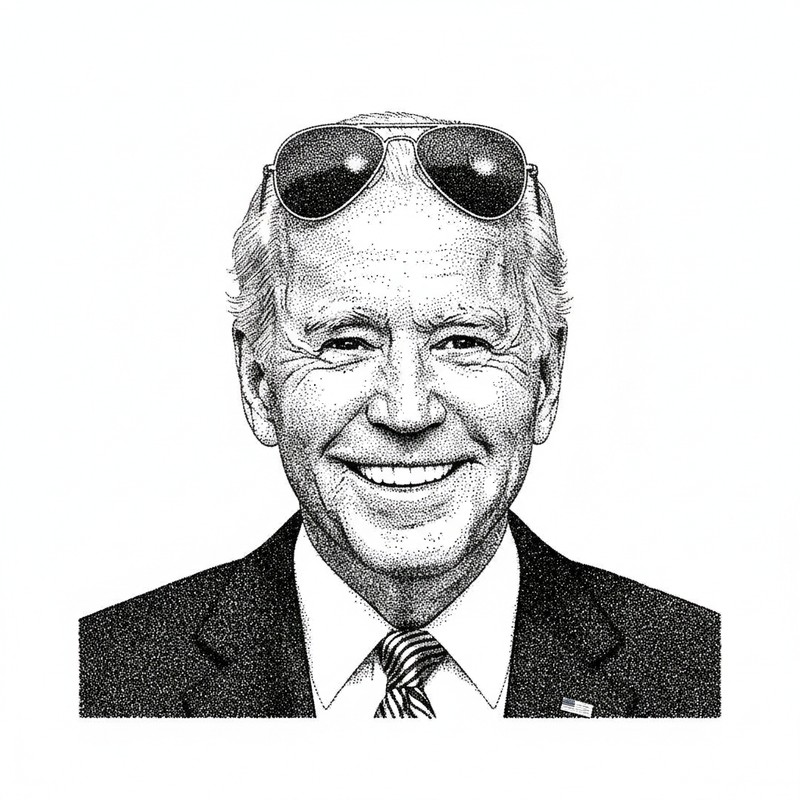
Case File #JB-2025-0415. Subject: Joseph Robinette Biden Jr. Filed under: Presidents of the United States (46th); Career Politicians Spanning Five Decades; Men Who Have Touched the Shoulders of More Black Pastors Than Any Non-Ordained Person in American History; Individuals Whose Relationship with the Black Community Is Best Described as “Complicated at Thanksgiving.”
The Board of Review has opened a formal evaluation into the N-Word Pass eligibility of Joseph Robinette Biden Jr., the 46th President of the United States, former Vice President under Barack Obama, former Senator from Delaware for thirty-six years, and a man who has spent approximately half a century cultivating relationships with Black voters while periodically saying things that make those voters close their eyes and inhale slowly through their noses.
The biographical record. Joseph Biden was born on November 20, 1942, in Scranton, Pennsylvania, to a working-class Irish Catholic family. He moved to Claymont, Delaware, at age ten. He attended the University of Delaware, then Syracuse University College of Law, where he graduated 76th out of 85 students, a detail he has never been eager to publicize but which the Board enters into the record for completeness. He was elected to the United States Senate in 1972 at the age of twenty-nine, making him one of the youngest senators in American history. He remained in the Senate until 2009, when he became Vice President of the United States under Barack Obama.
His political career has been, in the Board’s assessment, a continuous negotiation between genuine empathy and institutional inertia. He eulogized Strom Thurmond, a man who ran for president on a segregationist platform in 1948. He also delivered a eulogy for John Lewis, a man who bled on the Edmund Pettus Bridge fighting for voting rights. The fact that both of these relationships existed within the same career is not a contradiction Biden has ever fully reconciled, and it sits at the center of this evaluation.
The question before the Board is direct: does a lifetime in politics, including eight years as the first Black president’s second-in-command, translate into the cultural standing necessary for issuance of the Official N-Word Pass?
Cultural Context
The N-Word Pass evaluation framework does not grant special consideration to elected officials. A senator’s vote on a civil rights bill and a rapper’s community investment are evaluated on the same axis: what did you give back, and was it proportional to what you took? Political office provides extraordinary power to affect Black communities, for better and worse. That power raises the stakes of the evaluation but does not alter the criteria.
Biden’s relationship with Black America exists within a specific political tradition: the white Democratic politician who builds coalitions in Black communities through church visits, community center appearances, and the careful cultivation of endorsements from Black clergy and elected officials. This tradition has produced genuine policy outcomes. It has also produced a transactional dynamic in which Black votes are courted with promises, secured with presence, and occasionally taken for granted between election cycles.
The Board has evaluated other figures at the intersection of politics and Black culture. The Donald Trump evaluation examined policy outcomes versus rhetorical harm. The Hunter Biden evaluation explored the intersection of political privilege and personal engagement. The elder Biden’s case is distinct from both, because his record is longer, more public, and more internally contradictory than either.
The Case For
The Obama Partnership Was Real and Sustained
In 2008, Barack Obama selected Joe Biden as his running mate. That selection was strategic: Biden brought foreign policy experience, working-class appeal, and the Amtrak-riding everyman persona that Obama’s campaign believed would balance the ticket. But the relationship that developed over the subsequent eight years exceeded political convenience. Multiple accounts from White House staff describe a partnership built on genuine mutual respect, regular private lunches, and the kind of candor that only develops when two people actually trust each other.
Obama chose Biden. That choice carries weight within the Board’s evaluation framework. When the first Black president selects someone as his most intimate political partner and maintains that partnership across eight years and beyond, that constitutes a co-sign of extraordinary magnitude. Obama did not have to remain close to Biden after leaving office. He did. Their relationship persisted through Biden’s own presidential campaign, where Obama’s endorsement, delivered with visible emotion, was among the most significant moments of the 2020 primary.
The Clyburn Endorsement Saved His Candidacy and Defined His Presidency
In February 2020, Biden’s presidential campaign was functionally dead. He had finished fourth in Iowa, fifth in New Hampshire, and second in Nevada. The political obituaries were being drafted. Then James Clyburn, the most influential Black politician in South Carolina and the Majority Whip of the United States House of Representatives, endorsed Biden. Three days later, Biden won the South Carolina primary by nearly thirty points. The cascade that followed produced the nomination and, eventually, the presidency.
Clyburn’s endorsement was not transactional. It was personal. Clyburn stated publicly that Biden had been a consistent ally on issues affecting Black South Carolinians for decades. The endorsement reflected a relationship built over years of actual engagement, not a last-minute photo opportunity. The Board notes that earning the personal endorsement of a figure like Clyburn requires a track record that cannot be fabricated.
Kamala Harris as Vice President Was a Historic Selection
Biden selected Kamala Harris as his running mate, making her the first Black woman, first South Asian woman, and first woman of any background to serve as Vice President of the United States. The selection was not without political calculation. But the Board’s evaluation framework examines outcomes rather than motivations. The outcome was the placement of a Black woman one heartbeat from the presidency, which is a structural investment in Black political representation that no amount of church visits can replicate.
Judicial Appointments Changed the Federal Bench
Biden appointed Ketanji Brown Jackson as the first Black woman to serve on the Supreme Court of the United States. His broader judicial appointment record includes more Black women on the federal bench than any previous president. These appointments carry consequences that extend decades beyond a single presidency. The Board weighs institutional power-sharing heavily, and Biden’s judicial record represents a significant transfer of structural power to Black legal professionals.
The Case Against
”You Ain’t Black” Was Not a Gaffe. It Was a Revelation.
In May 2020, during an interview with Charlamagne tha God on “The Breakfast Club,” Biden stated: “If you have a problem figuring out whether you’re for me or Trump, then you ain’t Black.” The statement was delivered with the casual confidence of a man who believed he was making a joke among friends. He was not among friends. He was on a nationally syndicated radio show speaking to millions of Black listeners.
The Board must examine what the statement reveals. It reveals a politician so accustomed to Black voter loyalty that he treated it as an identity category rather than a political choice. It suggests a worldview in which Blackness and Democratic Party allegiance are interchangeable, which reduces a complex, heterogeneous community to a voting bloc. Biden apologized quickly. The apology was accepted by many. But the words existed, and they revealed an assumption that the Board cannot overlook.
The 1994 Violent Crime Control and Law Enforcement Act
Biden authored the 1994 crime bill. The legislation expanded federal death penalty offenses, funded 100,000 new police officers, incentivized states to build more prisons, and included a “three strikes” provision mandating life sentences for repeat offenders. The bill’s impact on Black communities has been extensively documented: mass incarceration rates that devastated a generation of Black families, disproportionate enforcement that targeted Black neighborhoods, and a prison-industrial expansion that produced incarceration rates without parallel in the developed world.
Biden has acknowledged that portions of the bill produced harmful outcomes. He has not, in the Board’s assessment, demonstrated the kind of sustained reckoning with the legislation’s consequences that the severity of those consequences demands. Acknowledgment is not accountability. The bill remains the single most consequential piece of legislation in the mass incarceration crisis, and Biden’s name is on it.
The Strom Thurmond Eulogy
In 2003, Biden delivered a eulogy at the funeral of Strom Thurmond, who ran for president in 1948 on a platform of racial segregation. The eulogy praised Thurmond’s character and their friendship. The Board understands the political customs surrounding funerals and the tradition of speaking generously about the deceased. The Board also understands that Strom Thurmond filibustered the Civil Rights Act of 1957 for over twenty-four hours. The decision to eulogize a segregationist warmly, regardless of personal friendship, reflects a comfort with proximity to racist political figures that the Board finds difficult to reconcile with genuine allyship.
The Pattern of Racially Clumsy Statements
The “you ain’t Black” comment was not an isolated incident. Biden described Barack Obama as “the first mainstream African-American who is articulate and bright and clean” in 2007. He told a predominantly Black audience in 2012 that Mitt Romney would “put y’all back in chains.” He recounted, on multiple occasions, a story about working as a lifeguard at a predominantly Black swimming pool and his relationship with a man named “Corn Pop,” delivered with a narrative style that veered between genuine nostalgia and a community theater audition.
Each of these moments, taken individually, can be attributed to Biden’s well-documented tendency toward verbal imprecision. Taken collectively, they form a pattern: a white politician who believes his proximity to Black communities entitles him to a level of racial casualness that consistently exceeds his actual cultural standing.
Performative Comfort Is Not Cultural Fluency
Biden is comfortable in Black churches. He is comfortable at NAACP dinners. He is comfortable in barbershops during campaign season. This comfort is frequently cited as evidence of genuine connection. The Board distinguishes between political comfort in Black spaces, which is a professional skill cultivated over decades, and cultural fluency, which requires the kind of sustained, non-transactional engagement that extends beyond election cycles. Biden’s presence in Black spaces has been, with notable exceptions, tethered to political calendars.
Deeper Analysis
The Biden case illuminates a tension that the Board encounters frequently in evaluations of white politicians: the gap between structural power exercised on behalf of Black communities and the personal cultural standing that the N-Word Pass represents.
Biden’s policy record is substantial. The judicial appointments alone represent a generational shift in who holds power within the federal court system. The ACA, while not authored by Biden, was passed during his vice presidency and expanded health coverage for millions of Black Americans. His selection of Kamala Harris was historically significant. These are not symbolic gestures. They are exercises of institutional power that produced measurable outcomes.
But the N-Word Pass is not a policy award. It is an assessment of cultural standing, reciprocity, and trust at the personal and communal level. And here, Biden’s record is more complicated. The 1994 crime bill represents structural harm to Black communities at a scale that decades of subsequent policy cannot fully offset. The pattern of racially clumsy statements, while arguably harmless in isolation, reveals a relationship with Black culture that is more comfortable than it is informed.
The Obama evaluation examined a figure whose cultural fluency was innate and whose policy record reinforced it. Biden’s case is the inverse: a policy record that periodically serves Black communities attached to a cultural sensibility that periodically embarrasses them. The two do not cancel each other out. They coexist, awkwardly, in the same file.
The Board also notes the generational dimension. Biden’s political style was forged in an era when white politicians demonstrated racial allyship through physical presence in Black spaces: attending church services, walking through neighborhoods, learning the names of community leaders. That model was not insincere in Biden’s case, but it was incomplete. The younger generation of Black political observers has articulated, clearly and repeatedly, that presence is not the same as understanding, and that comfort in Black spaces does not equate to accountability for actions that harmed Black communities.
Official Verdict
DENIED. The Board of Review has determined that Joseph Robinette Biden Jr. does not meet the criteria for issuance of the Official N-Word Pass.
The determining factors are as follows: the 1994 crime bill authored by the subject produced mass incarceration outcomes that devastated Black communities at a generational scale, and the subject’s reckoning with those outcomes has been insufficient; the pattern of racially clumsy statements, including the “you ain’t Black” comment, reveals a presumption of cultural access that exceeds the subject’s actual standing; the eulogy for a segregationist senator reflects a tolerance for proximity to racist political figures that is incompatible with the cultural trust the pass represents; and the subject’s engagement with Black communities, while politically sustained, has been predominantly tethered to electoral cycles rather than non-transactional cultural investment.
Mitigating factors are entered into the record: the Obama partnership represents a genuine and sustained personal relationship with Black political leadership; the selection of Kamala Harris as Vice President was a historic exercise of institutional power; judicial appointments, particularly Ketanji Brown Jackson, represent structural investments in Black representation; and the Clyburn endorsement reflects a personal reputation among Black political leaders that the Board takes seriously.
The denial is issued with the observation that Biden’s case represents the limits of political allyship as a substitute for cultural standing. A lifetime of casting votes and attending services is not the same as a lifetime of cultural fluency and reciprocal engagement. The Board recognizes the distinction, even when the subject does not.
The pass remains in the vault. The file is closed.