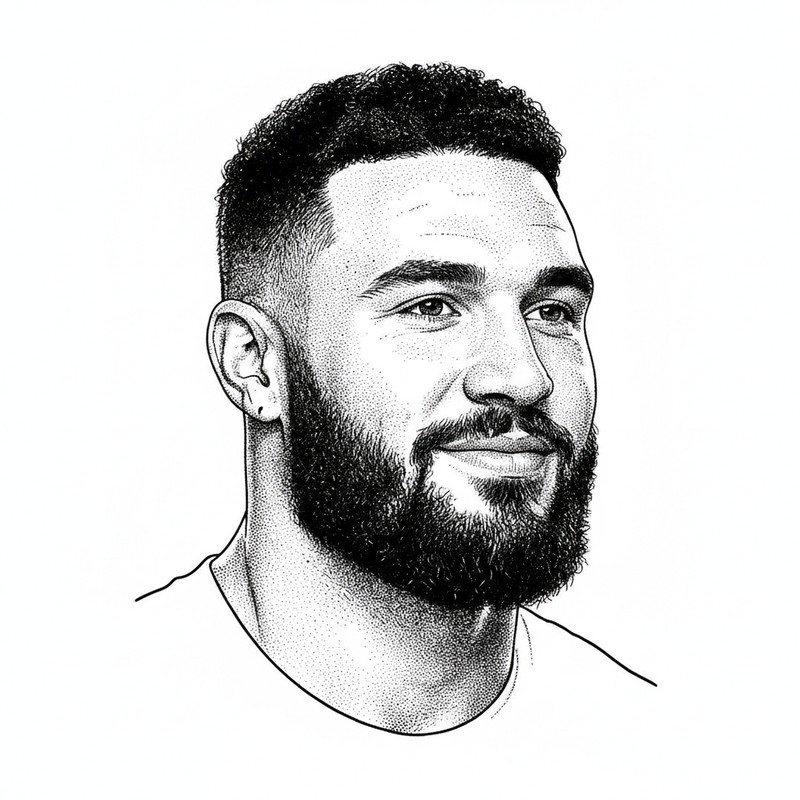
Introduction
Case File #TK-2026-0204. Subject: Travis Michael Kelce. Filed under: Professional Athletes (NFL); Tight Ends; Individuals Whose Relationship Status With Taylor Swift Has Generated More Media Coverage Than Most International Conflicts; Persons Whose Best Friend Is Patrick Mahomes, Which the Internet Has Decided Is Relevant to This Evaluation.
The Board of Review has opened a formal evaluation into the N-Word Pass eligibility of Travis Kelce, a tight end for the Kansas City Chiefs, a three-time Super Bowl champion, and a man whose cultural profile has expanded from “very good football player” to “very good football player who is dating the most famous woman on the planet” in a span of approximately eighteen months.
The question before the Board is one that emerges from a broader cultural pattern: the white professional athlete who spends the majority of his working life in Black cultural spaces (the NFL locker room, the football field, the post-game celebration) and whose closest professional relationships are with Black teammates. Does that sustained proximity, combined with the genuine camaraderie of professional sports, constitute the kind of cultural engagement the Board’s framework rewards?
The biographical record. Travis Kelce was born in 1989 in Westlake, Ohio, a suburb of Cleveland. His father, Ed Kelce, worked in steel sales. His mother, Donna Kelce, worked in banking. His brother, Jason Kelce, played center for the Philadelphia Eagles and became famous in his own right for a Super Bowl victory speech delivered in a mummer’s costume while visibly intoxicated, which the Board notes as background color rather than evaluative material.
Travis played football at the University of Cincinnati, was drafted by the Kansas City Chiefs in the third round of the 2013 NFL Draft, and has since become, by statistical consensus, one of the greatest tight ends in NFL history. He has won three Super Bowls, been selected to multiple Pro Bowls, and holds numerous franchise and NFL records. His on-field career is, by any standard, exceptional.
Off the field, Kelce hosted a reality dating show called “Catching Kelce” in 2016, which is the kind of career decision that the Board notes without commentary beyond observing that it existed. His relationship with Taylor Swift, which became public in late 2023, transformed him from a sports celebrity into a crossover cultural figure of the first order.
Cultural Context
The N-Word Pass evaluation framework evaluates cultural engagement, communal trust, and reciprocity. In cases involving white professional athletes in predominantly Black sports, the framework must distinguish between two types of proximity: the proximity that comes from sharing a locker room, and the proximity that comes from sharing a culture.
The NFL is approximately 57% Black. NFL locker rooms are, by composition, Black-majority workplaces. A white NFL player spends his professional life surrounded by Black colleagues, absorbing Black slang, Black music, Black cultural references, and the specific social dynamics that characterize a Black-majority professional environment. This proximity is sustained, intensive, and, by the accounts of most white NFL players, genuinely enjoyable.
The question is whether it constitutes cultural engagement or merely professional coexistence.
The Board has observed that white athletes in Black-majority sports frequently develop a social fluency with Black culture that is genuine, earned through years of shared experience, and limited to the specific context of the sport. They know the music. They know the slang. They know the handshakes. They do not, typically, know the history, the systemic context, or the community dynamics that exist outside the locker room. This gap between social fluency and cultural depth is the central issue in the Kelce evaluation.
The Case For
The Patrick Mahomes Friendship Is Genuine
Travis Kelce’s friendship with Patrick Mahomes, the Chiefs’ Black quarterback and one of the most talented players in NFL history, is, by all available evidence, genuine. They have played together since 2017. Their on-field chemistry is, by football analysis standards, historically productive. Their off-field friendship includes family gatherings, joint appearances, and the kind of sustained personal relationship that extends beyond professional obligation.
The Board notes this friendship as evidence of genuine cross-racial personal connection. The Board also notes that having a Black best friend, while personally meaningful, is not a pass qualification. The Kylie Jenner evaluation established this principle: personal relationships with Black individuals demonstrate personal character but do not constitute cultural engagement as defined by the Board’s framework.
Locker Room Culture Provides Sustained Exposure
Kelce has spent over a decade in NFL locker rooms, which are, as noted above, Black-majority professional environments. This sustained exposure has, by the available evidence, produced genuine social fluency with Black cultural dynamics. He appears comfortable in these spaces in a way that is not performed. His teammates appear comfortable with him in a way that suggests genuine trust.
He Has Not Committed Racial Offenses
The Board’s research team has reviewed the public record and found no documented instances of Travis Kelce using racial slurs, expressing racist views, or engaging in racially insensitive behavior. In a league where white players occasionally generate racial controversies, Kelce’s record is clean. This is noted as a positive indicator of character.
The “New Heights” Podcast Operates in a Cross-Cultural Space
Kelce co-hosts the “New Heights” podcast with his brother Jason. The podcast regularly features discussions of NFL culture, which includes substantial engagement with the language, humor, and social dynamics of a Black-majority workplace. The podcast’s audience is diverse, and its content reflects the multicultural environment of professional football.
The Case Against
Proximity Through Sports Is Not Cultural Contribution
The Board addresses the central issue. Playing football with Black teammates is a professional experience, not a cultural contribution. It provides exposure. It builds relationships. It develops social fluency. It does not constitute the kind of sustained, intentional, reciprocal engagement with Black culture that the Board’s framework evaluates.
The distinction is between being immersed in Black professional culture because your job requires it and choosing to engage with Black culture because of a genuine personal commitment. One is passive (you are placed in the environment by your career). The other is active (you seek the engagement because of who you are). Kelce’s engagement falls into the former category.
No Evidence of Community Investment in Black Spaces
The Board has reviewed Travis Kelce’s charitable activities. His Eighty-Seven & Running Foundation focuses on disadvantaged youth in the Kansas City area. This is admirable work. It is not directed specifically at Black communities or Black community infrastructure, and the Board’s framework evaluates targeted reciprocity as a significant factor.
The absence of targeted investment in Black communities is notable given the degree to which Kelce’s career has been built in Black-majority professional environments. The locker room provides cultural access. The question is whether anything has been given back to the culture that provided it.
Taylor Swift Relationship Has Shifted Cultural Positioning
Since his relationship with Taylor Swift became public, Kelce’s cultural positioning has shifted from “NFL star in a Black-majority sport” to “Taylor Swift’s boyfriend.” This is not a racial assessment. It is an observation that his primary cultural association in the public mind is now with one of the whitest cultural figures in American entertainment. This shift does not diminish his years of locker room relationships, but it does contextualize the trajectory: his cultural center of gravity is not moving toward deeper engagement with Black culture.
He Grew Up in White Suburban Ohio
Travis Kelce’s formative environment was Westlake, Ohio, a suburb of Cleveland where the population is approximately 90% white. His cultural formation was suburban, white, and Midwestern. His exposure to Black culture began when he entered college football and deepened when he entered the NFL. This is a professional pathway to cultural exposure, not a formative one, and the Board’s framework evaluates formative experiences more heavily than professional ones.
The Dating Show Precedent
“Catching Kelce” was a reality dating show in which women competed for the opportunity to date Travis Kelce. The Board notes that reality dating shows are not cultural credentials and moves on, though the research team has requested that this observation be entered into the permanent record as a matter of institutional opinion.
Deeper Analysis
The Travis Kelce evaluation illuminates a question that the Board encounters in every case involving white athletes in Black-majority sports: where does professional proximity end and cultural engagement begin?
The Board’s position is that professional proximity is necessary but not sufficient. Necessary because it provides the exposure and relationship-building that can lead to genuine cultural engagement. Not sufficient because it operates within a structured, compensated, professionally managed environment that is fundamentally different from the organic, unstructured, unpaid cultural engagement that characterizes authentic community relationships.
Kelce’s locker room relationships are real. His friendship with Mahomes is genuine. His comfort in Black professional spaces is evident. None of this is fabricated. But the Board evaluates what happens outside the structured environment: the community investment, the cultural study, the institutional commitment, the sustained engagement that extends beyond what the job provides. And on those dimensions, Kelce’s record is thin.
The comparison with The Rock’s evaluation is instructive. Dwayne Johnson’s relationship with Black culture was not just professional (wrestling), it was familial (his father), formative (his upbringing), and institutional (his philanthropic investments). Kelce’s relationship is professional. The difference in depth is the difference between approval and denial.
The Ed Sheeran evaluation examined a similar dynamic in a musical context: a white artist with genuine professional relationships with Black collaborators, but whose cultural engagement did not extend beyond the professional into the communal. The same principle applies here.
The Board also notes the specific cultural moment of the Kelce evaluation. As of this filing, Travis Kelce is perhaps the most visible white man in America. His relationship with Taylor Swift has placed him at the center of the American cultural conversation. This visibility creates both opportunity and scrutiny. If Kelce chose to leverage his platform for sustained engagement with Black community issues, the impact would be significant. The Board does not condition its evaluations on hypothetical future behavior, but it notes the opportunity for the record.
Official Verdict
DENIED. The Board of Review has determined that Travis Michael Kelce does not meet the criteria for issuance of the Official N-Word Pass.
The determining factors are as follows: cultural engagement limited to professional proximity in NFL locker rooms does not constitute the sustained, intentional, reciprocal engagement the Board’s framework requires; formative environment in white suburban Ohio provided no meaningful exposure to Black cultural communities; the absence of targeted institutional investment in Black communities indicates a gap in structural reciprocity; and proximity to Black culture through sports, while genuine, is a function of professional placement rather than personal commitment.
Mitigating factors are noted: genuine friendships with Black teammates, particularly Patrick Mahomes, are acknowledged; a clean record regarding racial conduct is appreciated; and comfort in Black-majority professional environments suggests a personal character free from racial hostility.
The denial is issued with the observation that professional proximity creates a foundation on which genuine cultural engagement could be built. Should Kelce develop sustained investments in Black community infrastructure, engage with Black cultural institutions beyond the locker room, and demonstrate that his exposure to Black culture has produced a commitment that extends beyond the workplace, a future review may reach a different conclusion. For now, proximity is not enough. The application is denied.