Introduction
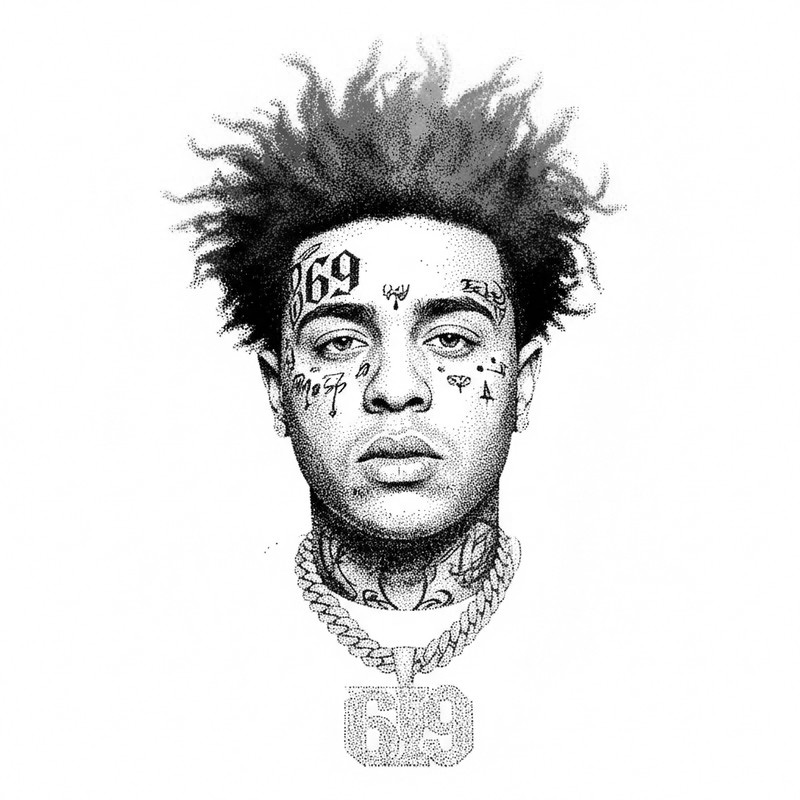
Case File #69-2026-0309. Subject: Daniel Hernandez, operating under the professional alias “6ix9ine” (also styled as “Tekashi69”). Filed under: Entertainers, Rap; Federal Cooperating Witnesses; Individuals Whose Hair Color Has Been Entered Into Evidence.
The Board of Review has opened a formal evaluation into the N-Word Pass eligibility of Daniel Hernandez. Born on May 8, 1996, to a Mexican mother and a Puerto Rican father, Hernandez grew up in Bushwick, Brooklyn, in the shadow of elevated subway tracks in a neighborhood where bodegas outnumbered banks and survival often depended on knowing which block belonged to which crew. His biological father was murdered when Daniel was a toddler. His stepfather, also later killed, provided sporadic stability. Young Daniel bounced between schools, worked the register at a Stay Fresh deli, and found solace in two things: anime and the aggressive rap pouring from car speakers on every corner.
His early aesthetic telegraphed maximum chaos. He tattooed the number 69 across his body (and face, and neck, and everywhere else skin was available), dyed his hair every color the Crayola corporation has ever manufactured, and cultivated an online persona built on confrontation. By 2017, his track “Gummo” exploded on SoundCloud and YouTube. The song was a snarling, bass-heavy declaration of street credentials delivered with the subtlety of a car alarm at 3 AM. It also featured the N-word used freely, frequently, and without any apparent hesitation.
The music industry shrugged, partly because 6ix9ine’s aggression generated clicks and partly because the lines around who could say the word in New York hip-hop had always been complicated by the city’s Latino population. But the shrug did not last. As 6ix9ine’s fame grew, so did scrutiny of his racial identity, his gang affiliations, his criminal charges, and eventually his decision to cooperate with federal prosecutors in a move that earned him the most damaging label in hip-hop: snitch.
His story is a turbocharged collision of racial identity, cultural borrowing, street credibility, institutional betrayal, and internet trolling. It is also, for our purposes, a case study in how quickly cultural capital can evaporate. Let us break it all down.
Cultural Context & Historical Background
The N-word’s journey from slave ship to studio booth is the most loaded linguistic odyssey in American history. Black communities reclaimed the softer variant as an act of defiance and intimacy, turning a weapon into a handshake. The rules around who can participate in that handshake remain fiercely debated, but one principle holds fairly steady: the word belongs to Black people, and access for others depends on context, trust, and communal approval.
New York City complicates this in ways that Des Moines does not. In boroughs like the Bronx, Brooklyn, and Queens, Black and Latino communities have shared neighborhoods, schools, churches, and cultural spaces for generations. Hip-hop itself was born from this cohabitation. DJ Kool Herc was Jamaican. The Rock Steady Crew was predominantly Puerto Rican. Graffiti crews mixed backgrounds like subway paint colors. In this environment, the N-word migrated across racial lines with a fluidity that scandalized outsiders but felt organic to participants.
This does not mean the word became racially neutral. Black New Yorkers maintained primary ownership. But the city’s cultural blending created a grey zone where some Latino artists used the word without immediate backlash, provided their community ties ran deep enough. Fat Joe, Big Pun, and later Cardi B all navigated this territory with varying degrees of acceptance and criticism.
6ix9ine entered this grey zone with the subtlety of a bulldozer. He did not ease into the word or deploy it sparingly. He built entire songs around it, shouting it with the enthusiasm of a sports announcer calling a game-winning touchdown. His position was essentially: “I’m from Brooklyn, I grew up in this, and I’m going to say it as much as I want.” The internet responded with a debate that generated enough heat to power the Barclays Center for a calendar year.
Our evaluation framework considers racial identity, community acceptance, cultural contribution, and demonstrated respect. 6ix9ine’s case tests every one of these criteria in ways that are, to put it mildly, stressful for the reviewing committee.
Pros
Genuine Inner-City Upbringing
Daniel Hernandez did not grow up in a gated subdivision and discover rap through a Spotify algorithm. He grew up in Bushwick during a period when the neighborhood was still rough, before artisanal coffee shops colonized every storefront. He attended public schools alongside Black and Latino kids. He lost family members to street violence. He worked minimum-wage jobs. His proximity to Black culture was not curated or optional. It was the texture of daily life.
This matters because our evaluation weighs lived experience. 6ix9ine’s childhood was shaped by the same economic deprivation, neighborhood violence, and institutional neglect that characterized many Black communities in early-2000s Brooklyn. He did not arrive at the N-word through a podcast or a Drake album. He heard it at the corner store before he could read.
The New York Latino-Black Cultural Exchange Precedent
As noted above, New York has a documented history of cross-racial N-word usage within tightly knit neighborhood contexts. 6ix9ine is not the first Latino artist from Brooklyn to use the word in music. Fat Joe has discussed this publicly, arguing that the word in New York functions differently among people who share blocks and bloodlines. Whether you agree with this framing or not, it provides a cultural precedent that 6ix9ine’s usage exists within, even if he stretched it past the breaking point.
Early Community Co-Signs (Before Everything Fell Apart)
Before the federal case, 6ix9ine collaborated with established Black artists. His track “FEFE” featured Nicki Minaj. “KANGA” included Kanye West. He had visible relationships with members of the Nine Trey Gangsta Bloods, a predominantly Black gang. These associations, however transactional they ultimately proved to be, represented a period when some corners of Black hip-hop accepted his presence without objection.
Cons
He Is Not Black
This is the foundational issue. Daniel Hernandez is Mexican and Puerto Rican. He is not Black. The N-Word Pass, in its most basic formulation, is rooted in Black identity and Black communal trust. While the New York grey zone provides some cultural context, it does not override the fundamental principle that the word belongs to Black people. 6ix9ine’s usage was prolific, casual, and commercial. He did not use the word in private conversation with close friends. He broadcast it to millions of listeners through chart-topping singles, monetizing a word whose pain he did not inherit.
The Volume and Commercialization of Usage
There is a difference between a Latino kid in Bed-Stuy using the word among friends on the stoop and a platinum-selling artist screaming it into Auto-Tuned microphones distributed globally through streaming platforms. 6ix9ine did not just use the word. He commodified it. Every stream of “Gummo” or “Kooda” generated revenue from a word whose emotional and historical weight belongs to a community he is not part of. Scale matters. Context that might be acceptable on a Brooklyn street corner becomes appropriation when amplified to 500 million YouTube views.
Federal Cooperation and the Destruction of Street Credibility
In September 2019, 6ix9ine pleaded guilty to nine federal charges including racketeering, firearms offenses, and drug trafficking. He then cooperated extensively with prosecutors, testifying against former associates in the Nine Trey Gangsta Bloods. He named names, identified gang members from photographs, and detailed criminal operations on the witness stand.
In hip-hop culture, cooperating with law enforcement is the ultimate betrayal. The code of silence is not merely a preference. It is a foundational value, particularly in communities where police have historically functioned as an occupying force rather than a protective service. By snitching, 6ix9ine did not just lose street credibility. He incinerated it. Whatever communal goodwill he had accumulated from his Brooklyn upbringing and gang associations vaporized the moment he raised his right hand and started talking.
The N-Word Pass is, at its core, a trust instrument. It represents communal acceptance. You cannot maintain communal acceptance when the community you claim to belong to has unanimously declared you a traitor. Black hip-hop’s verdict on 6ix9ine post-cooperation was swift, merciless, and permanent.
Trolling as a Substitute for Respect
After his release from prison (with a reduced sentence, courtesy of his cooperation), 6ix9ine returned to social media with the same aggressive trolling that had fueled his rise. He mocked rappers who had been shot. He taunted former associates. He posted from locations that seemed designed to provoke retaliation. He treated the entire culture as a content farm for engagement metrics.
This behavior is the opposite of the respect and humility our evaluation framework requires. The N-Word Pass is not a toy. It is not a weapon for Instagram beefs. It is a marker of trust extended by a community that has endured centuries of linguistic violence. 6ix9ine’s approach to the word, and to the culture surrounding it, has consistently prioritized provocation over respect.
The Sexual Misconduct Case
In 2015, Hernandez pleaded guilty to use of a child in a sexual performance, a felony involving a 13-year-old girl. He received probation. This conviction does not directly relate to N-Word Pass criteria, but our Board of Review notes that communal trust, the foundation of any pass, is difficult to extend to individuals with this kind of record. The aunties at the cookout check backgrounds, and this one does not clear.
Deeper Cultural Analysis
6ix9ine’s case sits at the intersection of several cultural fault lines. The first is the ongoing debate about Latino access to the N-word, a conversation that plays out differently in New York, Los Angeles, Miami, and Houston. In New York, decades of shared space have created genuine cultural overlap between Black and Latino communities. But overlap is not equivalence. Sharing a block does not mean sharing a history of chattel slavery, Jim Crow, and the specific racial terror that produced the N-word as a weapon.
The second fault line is the commodification of transgression. 6ix9ine’s entire brand was built on doing things you are not supposed to do: joining gangs, trolling rivals, screaming slurs, and then snitching when consequences arrived. He treated cultural boundaries the same way he treated legal boundaries, as obstacles to be bulldozed for attention and profit. In a media landscape that rewards controversy with clicks, this strategy worked commercially. It failed culturally.
The third fault line is the question of what happens when communal trust is broken. Before the federal case, 6ix9ine existed in a contested but not entirely rejected space within hip-hop. Some Black artists worked with him. Some defended his use of the word. After the cooperation agreement, that space closed permanently. The snitching did not just end his gang career. It ended his cultural visa. Whatever conditional acceptance he had was revoked, and no amount of rainbow hair or aggressive Instagram posts could reinstate it.
Compare this trajectory with someone like Eminem, who built credibility through decades of consistent respect, community investment, and deference to Black hip-hop’s foundational values. Eminem never claimed to own the culture. He asked permission to participate and spent 25 years proving he deserved it. 6ix9ine claimed ownership of everything, respected nothing, and then cooperated with the institution the culture distrusts most: the federal government.
The N-Word Pass is not a song you can stream. It is a relationship you maintain. 6ix9ine does not maintain relationships. He extracts value from them and moves on. That approach is incompatible with the trust the pass represents.
Final Verdict
DENIED.
After extensive evaluation, the Board of Review has determined that Daniel Hernandez does not meet the criteria for issuance of the Official N-Word Pass. The application fails on multiple grounds.
He is not Black, which places him in the grey zone rather than the automatic-approval category. His usage of the word was commercially excessive, far exceeding what even the most generous interpretation of New York cultural exchange would permit. His federal cooperation destroyed the communal trust that might have sustained a conditional pass. His post-incarceration behavior demonstrates contempt rather than respect for the culture whose vocabulary he borrowed.
The vote was unanimous. The pass is denied. The file is closed. No appeal will be entertained.